
Heat pump stuck in heat mode in California

RepairHeat PumpCalifornia
Step 1 of 2

What ZIP code is the job in?

A heat pump stuck in heat mode usually means the reversing valve isn't shifting. That valve is what switches the system between heating and cooling, and it's controlled by a solenoid that can fail electrically or stick in one position mechanically. When it sticks, the system keeps running the same cycle no matter what the thermostat calls for. A stuck valve can also leave the indoor coil frosted over or cause warm air to blow when you've set the system to cool. Since most homes in California heat with gas, this problem usually shows up on the cooling side, when the house needs to come down and the system won't switch over. A stuck reversing valve isn't something to force past with the thermostat. It needs a technician to diagnose whether the valve, the solenoid, or the control board is the cause.

A gray outdoor heat pump unit on a concrete pad beside a house with horizontal lap siding, connected by conduit and a flexible line to a wall-mounted disconnect box, with low shrubs and mulch nearby.

Working as it should

When the reversing valve is shifting the way it's built to, the outdoor unit switches between heat and cool on command. Your thermostat calls for cool, the valve shifts, and the unit answers. With gas heat likely covering winter here, it's the cool side you're counting on through the warm months.


An outdoor air conditioner condenser unit on a concrete pad beside a house with horizontal siding above a concrete block foundation, with insulated refrigerant lines and a vertical white pipe on the wall.

Stuck on heat

If the valve won't shift, the unit keeps running in heat mode no matter what the thermostat asks for. On a warm California day that means no cooling at all, and a system that runs anyway, pulling power at some of the highest electric rates in the country without the relief you're paying for.

Why won't the house cool down when you switch it over

You set the thermostat to cool and the outdoor unit still blows warm air, or it short cycles and never gets the house down. Some homes feel the opposite: the system stays locked on cooling and the house won't warm up, though with gas heat covering most California winters, that version is less likely to get noticed right away. Either way the unit keeps running, trying to reach a setpoint it can't hit. That means longer run times, a system working harder than it should, and a bill reflecting it on some of the most expensive power rates in the country. Left alone, the compressor keeps straining against a system stuck in the wrong mode, and that's the part that's costly to replace.

A gray outdoor heat pump unit on a concrete pad beside a house with horizontal lap siding, with a conduit running to a wall-mounted disconnect box and a green shrub to the left.

The valve shifting the way it should

The outdoor unit sits clean on its pad, conduit running neat to the disconnect box. Call for cool and the valve shifts, the unit answers, warm air stops. With gas heat covering most winters here, this unit mainly needs to handle cooling when the weather turns warm.

An outdoor air conditioning condenser unit with dusty coils sits on a concrete pad against light horizontal siding, with an electrical disconnect box and refrigerant lines on the wall and a shrub and mulch at left.

Stuck on heat when you need cool

This unit has sat through years of weather, dirt built up on the cabinet. The reversing valve won't shift, so the thermostat calls for cool and warm air keeps coming. A stuck valve usually needs a contractor to open the system and replace it.

A woman with dark hair in a bun wearing a cream knit sweater sits on a gray sofa in a bright living room, looking off to the side.
A woman wrapped in a knit blanket sits on a gray sofa in a living room, looking toward a bright window with houseplants and an armchair in the background.
A woman in a gray cowl-neck sweater sits on a light sofa with cushions, smiling and looking to the side, with a kitchen and window visible behind her.
A woman with dark hair in a bun, wearing a light linen shirt, sits on a sofa and looks to the side, with a window, houseplants and a kitchen with pendant lights blurred behind her.

The reversing valve has a core that slides back and forth inside a metal body, and a solenoid on top pulls it from one side to the other when the thermostat calls for a different mode. Refrigerant still moves through the system even when that core is stuck, which is why the unit keeps running and air keeps coming out of the vents, just in the wrong mode. Sometimes you can hear it try. A hiss or a clack at the outdoor unit when the thermostat switches over means the solenoid is getting voltage but the core isn't moving all the way. Other times the solenoid is fine and the problem is refrigerant charge. The valve depends on a pressure difference to push the core across, and if the charge is low, there isn't enough pressure to move it even with good voltage at the coil. A contractor sorts out which one it is by checking voltage at the solenoid, then checking line temperatures on each side of the valve to see whether it actually shifted. Since the valve sits in the main line, fixing it means recovering the refrigerant and brazing in a new valve, not swapping a part off the shelf.

What's actually happening inside the valve

  • The reversing valve has a sliding core inside it, and a small solenoid coil on top is what pulls that core from one side to the other.
  • A failed solenoid still lets refrigerant flow, which is why the system runs and blows air, just not in the mode you asked for.
  • If the core sticks halfway, you can sometimes hear a hiss or clack at the outdoor unit when the thermostat tries to switch modes.
  • Low refrigerant charge can keep the valve from shifting even when the solenoid itself is fine, since the pressure difference is what actually moves the core.
  • A contractor checks this by measuring voltage at the solenoid first, then checking line temperatures on both sides of the valve to see if it actually moved.
  • Because the valve sits in the main refrigerant line, swapping it out means recovering refrigerant and brazing in a new one rather than just replacing a part.
A gray outdoor condenser unit on a concrete pad beside a house with horizontal lap siding, with a wall-mounted disconnect box, conduit and insulated refrigerant lines, a shrub at left and gravel at right.
The unit sits clean on the pad, lines and conduit running neat to the disconnect, ready to answer either mode you ask for.
An outdoor air conditioning condenser unit on a concrete pad beside a house with horizontal lap siding, with a green shrub to the left and a wide concrete slab in the foreground.
The same unit, same pad, blowing heat with the thermostat set to cool and no sign of a problem from the outside.

Wait It Out or Call Now

Live with it for now

  • The system still heats, so the house stays warm while you wait on a repair.
  • Running it stuck in heat mode on a warm day pushes the indoor coil and compressor to work against conditions they weren't asked for.
  • Power here is expensive, and a unit fighting the wrong mode all day adds to that bill without cooling anything down.
  • A stuck reversing valve doesn't fix itself, so the longer it runs this way, the longer the house goes without real cooling on a hot stretch.
  • If the solenoid has failed electrically, nothing about waiting changes what a contractor will eventually need to replace.

Get it looked at now

  • A contractor can test the solenoid and the valve itself to find out which one is actually failing.
  • Fixing the valve restores both modes, so the system goes back to switching to cooling on command, not just heating.
  • You skip the work of searching out contractors, calling around, and explaining the same problem more than once.
  • Getting matched with a contractor who handles heat pumps means the diagnosis starts from what you've already described, not from scratch.
  • With most homes here heating on gas, this repair is really about getting the one job this unit does for you, cooling, working again.
A two-story house with light beige horizontal siding, a gabled roof, a small covered front porch with dark door, and shrubs along the foundation, set behind a mown lawn and wet sidewalk with large leafy trees on both sides.

California air averages a 50°F dew point through June, July and August, a figure the National Weather Service uses to describe how dry the air sits even on warm afternoons. That matters here because a heat pump stuck in heat mode isn't fighting damp air on top of everything else. The house will still run warm indoors, but you won't get the sticky, heavy feeling that makes a broken AC unbearable in muggier states. That's little comfort when the system's stuck, though. Instead of calling around to find someone who works on heat pumps, explaining the reversing valve problem more than once, and sorting through quotes yourself, you can get matched with a contractor who takes it from there.

NASA POWER T2MDEW county cells weighted by homes

A pro who works on heat pumps

Describe what your heat pump is doing once, in one form.

No charge to send it. You decide if you hire them.

How the valve gets its signal

  • A thermostat call for cool sends 24 volts to the reversing valve's solenoid, telling it to shift the slide.
  • If the solenoid coil has failed or burned out, that signal goes nowhere and the valve stays put.
  • A valve can also stick from a worn seal or built-up debris, even when the solenoid itself is getting power.
  • Low refrigerant charge sometimes keeps the valve from shifting fully, since pressure helps push the slide across.
  • A technician checks for voltage at the solenoid first, then moves to the valve body if the signal is reaching it.
  • Tapping the valve body while it's calling for a shift is one way a tech checks for a mechanically stuck slide.

The reversing valve only moves when it's told to, and that order travels a specific path. The thermostat sends a low voltage signal down to the outdoor unit, and that signal energizes the solenoid coil sitting on top of the valve. The coil is an electromagnet. When it's working, it pulls a slide inside the valve body from one side to the other, and that slide is what routes refrigerant one way for heat and the other way for cool. Nothing about the compressor or the rest of the system changes. Only that one slide decides which mode you get.

A few things break that chain. The coil itself can burn out, so no signal ever reaches the slide even though the thermostat sent it. The slide can also seize in place from a worn seal or debris that's built up inside the valve body over time, and in that case the coil can be getting power just fine while the valve ignores it. Refrigerant pressure plays a part too. The system relies on that pressure to help push the slide across, so a low charge can leave it stuck halfway or not moving at all.

A technician works through this in order. Voltage at the solenoid first, to see if the signal is even arriving. If it is, the next step is the valve body itself, sometimes tapping it while it's calling for a shift to see if a stuck slide breaks free.

An outdoor air conditioner condenser unit on a concrete pad beside a house with beige vinyl siding, with a gray electrical disconnect box and insulated refrigerant lines on the wall and river rock to the right.
Before you get your heat pump repair
A gray outdoor condenser unit sits on a concrete pad against a house wall with horizontal siding above a stone veneer base, with an electrical disconnect box and conduit on the wall and a leafy shrub in mulch to the left.
After you get your heat pump repair

Power costs 31.35 cents per kilowatt-hour statewide

At 31.35 cents per kilowatt-hour, a heat pump that won't switch out of heat mode costs you on a warm afternoon, since the outdoor unit keeps running without cooling the house. You're paying to move heat, just not in the direction you need it.

EIA-861 2025 statewide residential average

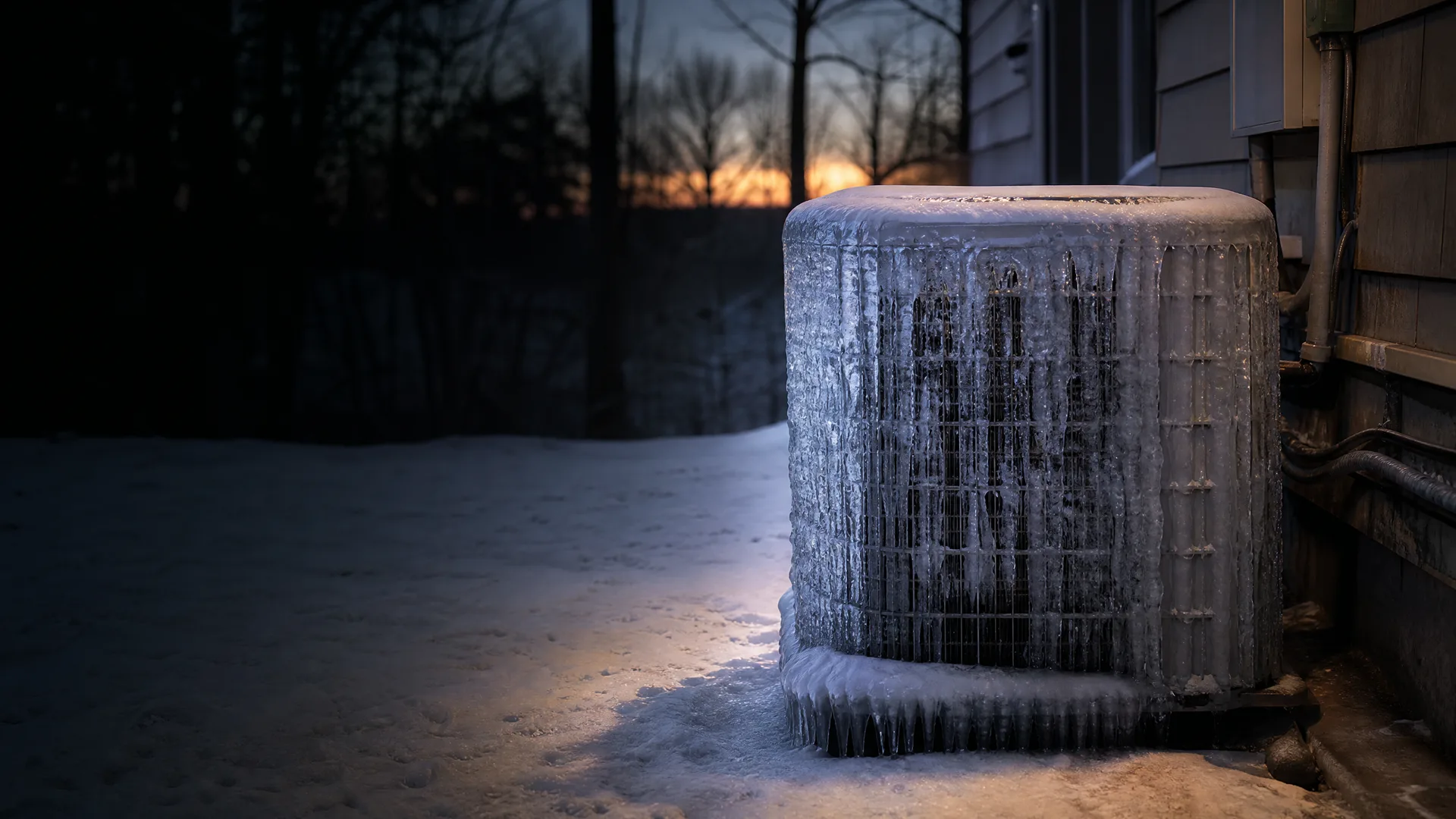
An outdoor condenser unit encased in thick ice stands on snow beside a house with horizontal siding and exterior pipes, with bare trees and a sunset glow in the background.

Dawn comes up gray in the side yard, and the outdoor unit sits under a coat of ice, thick over the coils and down the sides of the cabinet. It's January, and the valve never shifted back out of heat mode once the cold settled in overnight. The unit hums like it's trying, but no air moves through the ice. You can see your breath out there. Most houses nearby run on gas through mornings like this one, so the furnace is carrying the load while this sits frozen and useless on its pad. By the time the sun clears the fence line, the ice hasn't moved, and neither has the valve.

A woman stands in the open black front door of a white-sided house with a dark shingled roof while a man in a navy jacket approaches along the walkway, with lantern wall lights, a potted shrub, and flowering garden beds nearby.

A stuck reversing valve, found and fixed

The valve either shifts when the thermostat calls for it or it doesn't. Everything else on this page comes back to that one part and the solenoid that drives it. A stuck solenoid or a worn slide inside the valve, confirmed by someone who can test it, is what tells you what's actually wrong.

You don't have to track down who handles heat pumps in your area or spend your afternoon on the phone explaining the same thing three times to three different companies. Answer a few questions about what the unit is doing and you get matched with a contractor who works on this equipment, and they'll reach out to you directly. From there you're talking to someone who already knows what you're dealing with.

Interior corner of a dining room with a round wooden table, a ceramic vase holding olive branches, a dark spindle-back chair near a curtained window, and a sideboard with a lamp against beige walls.
A smiling older woman with gray hair in a cream knit sweater stands in a dimly lit kitchen beside a window showing snow outside, with a round loaf of bread on the counter in the foreground.
A woman and a child wrapped together in a thick knitted blanket on a sofa, both with eyes closed, with a lit table lamp and houseplant in the dim background.

Get your heat pump to the right pro

A heat pump stuck in heat mode comes down to the reversing valve or the solenoid that drives it, and that's a job for someone who works on these systems regularly, not a guess-and-check repair. Finding that person usually means searching, calling a few contractors, explaining the same problem each time, then sorting through quotes. Tell us what's going on and you're matched with a contractor who handles this equipment, and they'll reach out to you directly. No repeating yourself, no calling around.

Connect with a pro

Answer a few questions instead of calling shop after shop.

There's no charge for the request.