






Profile view of a bearded man wearing a dark green baseball cap and a dark gray T-shirt against a plain light background.

How long an AC takes to cool a house in California

Tune-up, service, or cleaningCentral ACCalifornia
Step 1 of 2

What ZIP code is the job in?

How long does it take for AC to cool down a house in California?

You turn the AC on after a hot afternoon and you're standing by the thermostat waiting for the number to drop. You want to know if an hour is normal, or if something's wrong with the system. The answer depends less on the heat outside and more on how hard the unit has to work to catch up, which is a different question than how hot it is.

Most homes take one to three hours to cool down a few degrees

A properly working AC drops a house about one degree every fifteen to twenty minutes once it's running steady. So closing a five degree gap takes an hour and a half to two hours in most cases. California's dry heat actually works in your favor here, since the system isn't also fighting humidity out of the air before it can cool it. If it's taking much longer than that, or the house never quite catches up before the sun goes down again, the unit may be low on refrigerant, the coil may be dirty, or the system may simply be sized wrong for the house. A unit that runs for hours without closing the gap is working harder than it should, and that shows up on the power bill.

  1. The compressor starts and begins pressurizing refrigerant

  2. Cold refrigerant moves through the indoor coil

  3. The blower pulls warm air across that coil

  4. Cooled air pushes out through the ducts into rooms

A gray-haired, bearded man in a dark coat dusted with snow stands smiling in a dimly lit room with a lamp, mirror, framed art, and a sofa in the background.
An older man with white hair and a beard, wearing a dark snow-dusted coat and scarf, stands in a warmly lit interior hallway with a framed landscape picture, a table lamp and a potted plant behind him, and a snowy view through a window at left.
An older man in a dark snow-flecked overcoat and scarf stands smiling in a warmly lit home entryway, with a glass-paned door showing darkness outside and a lamp-lit room visible through a doorway behind him.
An older man with gray hair and a beard, wearing a dark snow-dusted jacket and scarf, stands smiling in a warmly lit interior hallway with a lit table lamp, a vase of dried branches, and a framed picture in the background.

What a Slow Cooldown Costs You

  • A system that worked fine last August but now takes much longer may be losing refrigerant or airflow.
  • Dirty coils and a clogged filter make the blower push less air, so every room takes longer to drop.
  • A house that never quite reaches the set temperature on a hot afternoon is running the compressor longer than it should.
  • Longer run times with power priced the way it is here show up fast on the bill.
  • A system straining to cool one or two rooms more than others points to a duct or airflow problem worth checking before next summer.
  • Catching a slow coil or a low charge before the hottest months means fewer surprise breakdowns when you need the system most.

If your house used to drop to temperature in half an hour and now it takes longer, that change is the clue. Nothing about a California summer makes an AC lose ground year over year. When it happens, the usual causes are a refrigerant leak or a coil and filter that have gone dirty enough to choke the airflow. Either way, the compressor ends up running longer to do the same job, and with what power costs here, that extra run time lands on the bill before you've even noticed the house feels different. A thermostat that never quite hits the number you set, especially mid-afternoon, is another version of the same problem: the system isn't failing, it's working harder than it should. So is a house where the living room cools fine but the back bedroom never catches up. That's usually airflow or ductwork, not the unit itself, and it's worth having looked at before the next heat wave rather than during one. None of this needs to turn into a breakdown. A coil that's losing efficiency or a system running low on charge will usually show itself first as a slower cooldown and a higher bill, and both are cheaper to deal with in spring than in August. Catching it early is the difference between a quick fix and a system that quits on the one day you need it most.

A woman wrapped in a thick beige fleece blanket sits on a sofa with an open book on her lap, beside a lit table lamp, with a frost-covered window behind her.
An older woman with gray hair in a bun and glasses, wearing a beige knit sweater, smiles while looking to the side in a warmly lit kitchen, with a loaf of bread on the counter in the foreground and a snowy scene outside the window.
A two-story house with gray and light gray siding, white-trimmed windows and a white front door, flanked by deciduous trees, with a partly browned lawn in front under a clear blue sky.

A 50°F dew point is what your summer air averages here, across June, July and August, according to NOAA climate data. That's dry air next to most of the country, and it's why your AC can actually hit the number on the thermostat instead of stalling a few degrees short. Dry air lets the coil pull heat out without fighting moisture at the same time, so cooling goes faster and the system shuts off sooner. But that only holds if the coil and airflow are in the shape they were last summer. A coil coated in dust or a blower working against a dirty filter slows that process down no matter how dry the air is outside. Keeping those parts clean is what lets your system use California's dry air to its advantage instead of losing that edge to buildup it can't shake off on its own.

NASA POWER T2MDEW county cells weighted by homes

Matched to your air conditioner job

A system that's taking longer than it used to isn't something to just live with until next summer. The dry air here means your AC should be able to pull a house down to temperature without much fight, so when it can't, the cause is usually something a technician can find in one visit: a coil that needs cleaning, a filter that's been ignored, refrigerant that's lower than it should be. Left alone, that gap tends to widen, and the unit spends more hours running to do the same job, which matters when power here costs what it does. Regular maintenance is what catches this before it turns into a system that runs most of the afternoon and still doesn't reach the number on the thermostat. If your cooling times have crept up or a room never quite gets there, that's worth having someone look at now, while it's still a small fix. Send the request and a contractor who handles this kind of work in your area will follow up.

A newer system in good shape

A well-kept AC in a California house can bring the temperature down in 30 to 45 minutes once it's running, especially with the dry air here helping the coil shed heat. The compressor holds steady pressure, the blower moves a full volume of air, and the thermostat doesn't have to fight for every degree. If your system was serviced within the last year and the filter's clean, this is the range you should expect on a hot afternoon.


An older system losing ground

A system that's a few years past its last service, or one nobody's checked on, can take an hour or more to do the same job, and some rooms may never quite hit the number on the thermostat. Refrigerant leaks slowly, coils collect dust, and a blower working harder than it should wears down faster. None of that shows up as a single clear symptom. It just shows up as the house staying warm longer than it used to, every summer a little more.

Power costs 31.35 cents per kilowatt-hour statewide

At 31.35 cents a kilowatt-hour, every extra minute your AC spends chasing the thermostat shows up on the bill. A system that still cools in 30 to 45 minutes is using less power to get there than one that's run long and lost its edge.

EIA-861 2025 statewide residential average

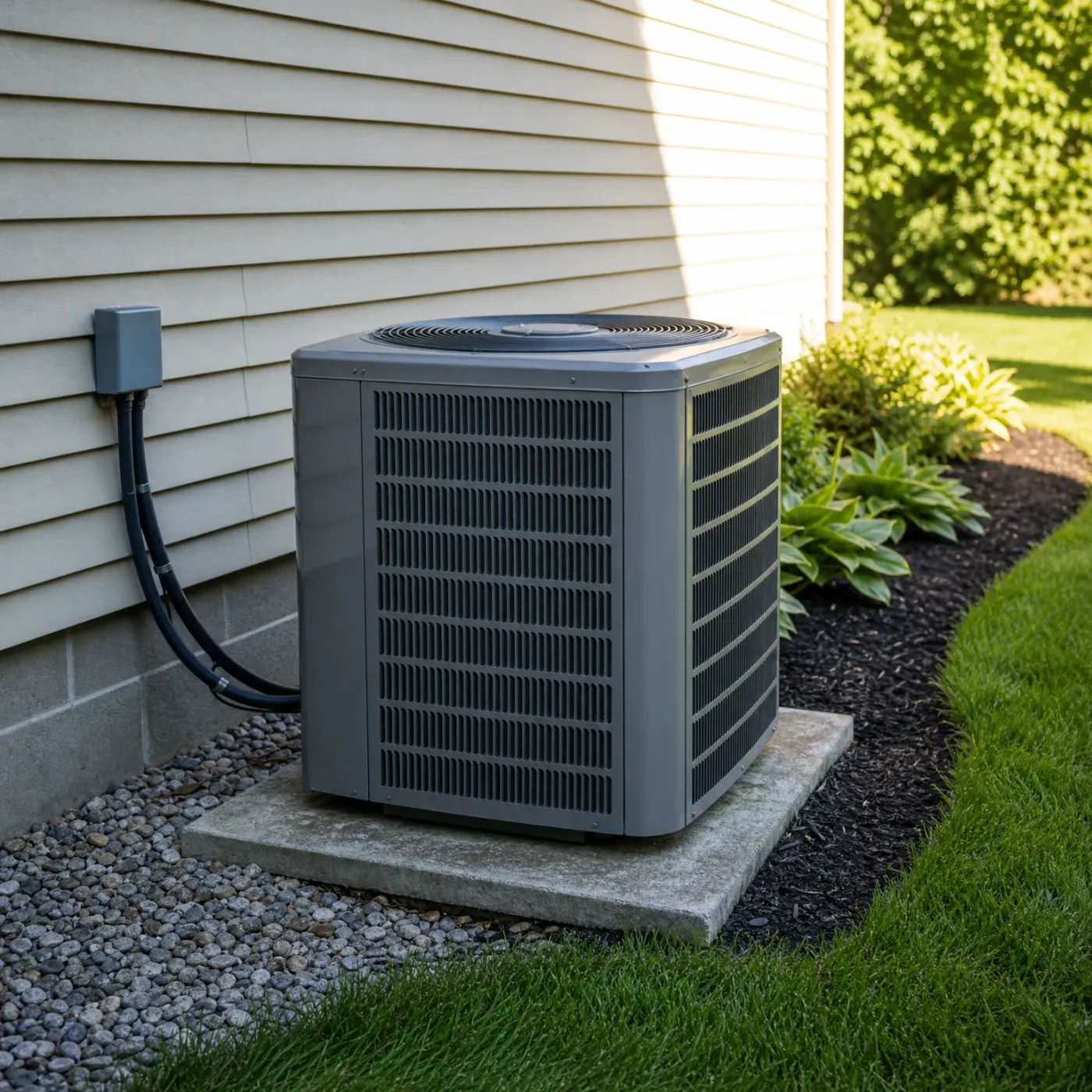
A gray outdoor air conditioner condenser unit on a concrete pad beside a house with horizontal siding and a light stucco wall, with a disconnect box and refrigerant lines on the wall and a shrub and mulch bed at left.

Running but not keeping up

A system can run for hours and still leave the house a few degrees above the setting. The compressor cycles, the blower moves air, but the house never catches up. That's different from a slow cooldown. It means the unit is losing the fight all day, not just taking longer to win it. Left alone through a second summer, it usually gets worse, not better.

A gray outdoor air conditioning condenser unit on a concrete pad surrounded by gravel, next to a white horizontal-lap-sided house wall with an electrical box and conduit, against a blank white background on the left.

Short cycling without cooling

Some systems shut off after a few minutes, then start again almost right away, without the house dropping much. That pattern points to a different problem than a slow pulldown. It can mean the thermostat is misreading the room, or the system is overheating internally and tripping off to protect itself. Either way, the house stays warm while the equipment keeps working, which is wasted run time on an expensive kilowatt-hour.

A man in a dark blue shirt stands in an open front doorway of a stucco and wood-clad house, facing a blond woman seen from behind in the foreground on a stone walkway.

A slow cooldown shows up in your house before it shows up on paper

You'll notice it in the room that's always been the hardest to cool. The one at the end of the hall, or over the garage, stays warm long after the thermostat says the house has reached temperature. That room is telling you the air isn't reaching it the way it used to, usually because the blower is pushing less of it than it should.

Left alone, this doesn't fix itself. The system keeps running longer to chase the same number, the power bill keeps reflecting that extra time, and the part causing the slowdown keeps working under strain until it fails outright. A contractor who looks at your system can tell you what's behind the slowdown and what it needs. Once you request that, the search is off your plate. Someone who knows this equipment takes it from there.

A living room corner with a beige sofa and cushion, a round wooden coffee table holding a pale ceramic vase of eucalyptus stems and a wooden bowl, and a curtained window with a potted plant above a latticed radiator cover in the background.
An outdoor air conditioner condenser unit beside a house with horizontal siding and stucco, its coil fins covered in white cottonwood fluff that also collects on the surrounding grass and mulch.

Late afternoon, and you're out pulling weeds along the side yard when you notice it. The condenser's been humming the whole time you've been out there, but the fins are packed white, like someone dusted the thing with snow. Cottonwood fluff, caught in every gap, thick enough you can't see metal underneath. It's been drifting past for weeks, landing on the patio, the windowsills, and apparently all over the unit nobody checks. You crouch down and brush a hand across it, and a layer comes away soft and dry. Behind it the fins are still packed tight. You straighten up, glance at the back door, and wonder how long the thing's been breathing through that.

A healthy AC in California gets a house cool in 30 to 45 minutes, helped by air that's dry enough to let the coil do its job. Past that, the system is working harder than it should to reach a number it used to hit without strain. A dirty coil, a weak capacitor, a refrigerant leak, these all show up the same way, as a cooldown that takes longer than it did last summer. You don't need to figure out which one it is. That's what a technician is for, and once you request service, the work of finding someone who can look at your system is off your plate. No more wondering if it'll hold through August. Whatever's slowing it down gets found and dealt with, and your house goes back to cooling the way it's supposed to.

A gray outdoor air conditioning condenser unit on a concrete pad beside a house with light horizontal siding, with gravel, dark mulch, shrubs and lawn nearby and a conduit box on the wall.

An air conditioner pro near you

Match me with a pro

Send the form and the air conditioner tune-up stops being something to remember.

Sending the form costs nothing.