Mini Split Installation in San Bernardino, CA
A new system here will heat from November through March and cool from May through October every year. Tell us about the house, and a licensed contractor who covers San Bernardino County will get in touch.
Tell us about the job
It takes about a minute.
San Bernardino asks a mini-split to run almost year round
Eleven months out of the year, a mini-split here is either heating or cooling the house. Summer afternoons average 99°F, and cooling runs May through October, six months of the compressor working hard most days. Heat is needed November through March, five months, with winter nights averaging 39°F from December through February.
A unit built on or after January 1, 2023 has to meet 14.3 SEER2 for cooling and 7.5 HSPF2 for heating. In a place that leans on cooling as long as this one does, that cooling number is the one doing the work most months.
- 5 months
- November through March, your system heats
- 6 months
- May through October, it cools
- 39°F
- the average winter night it heats against
- 99°F
- the average summer afternoon it cools against
NOAA nClimDiv, 1991–2020 normals
California requires HVAC contractors to hold a state license.
The CSLB tests contractors before they get that license and keeps a record of who holds one, so the license follows the contractor, not the job. It tells you the person doing the work was checked once, not that this particular installation was.
That's what stands behind the person you hire. What checks the installation itself is the permit. Replacing a system like a mini-split needs a permit from the local building office in most cities and counties, and an inspection once the work is done. That inspection is what looks at this job, not the contractor's history.
Sources: California Legislative Counsel · Contractors State License Board
- Is a mini split worth it?
- For most homes here, yes, especially if a room runs hot in summer or cold in winter without ductwork to fix it. San Bernardino summers average 99°F in the afternoon and winter nights drop to an average of 39°F, so a mini split earns its keep by handling both with one system. It also skips the duct losses a central system has, since it sends air straight into the room. The best way to know if it fits your house is to have a licensed contractor look at which rooms need it and size the unit for those rooms.
- How many rooms can a mini split cover?
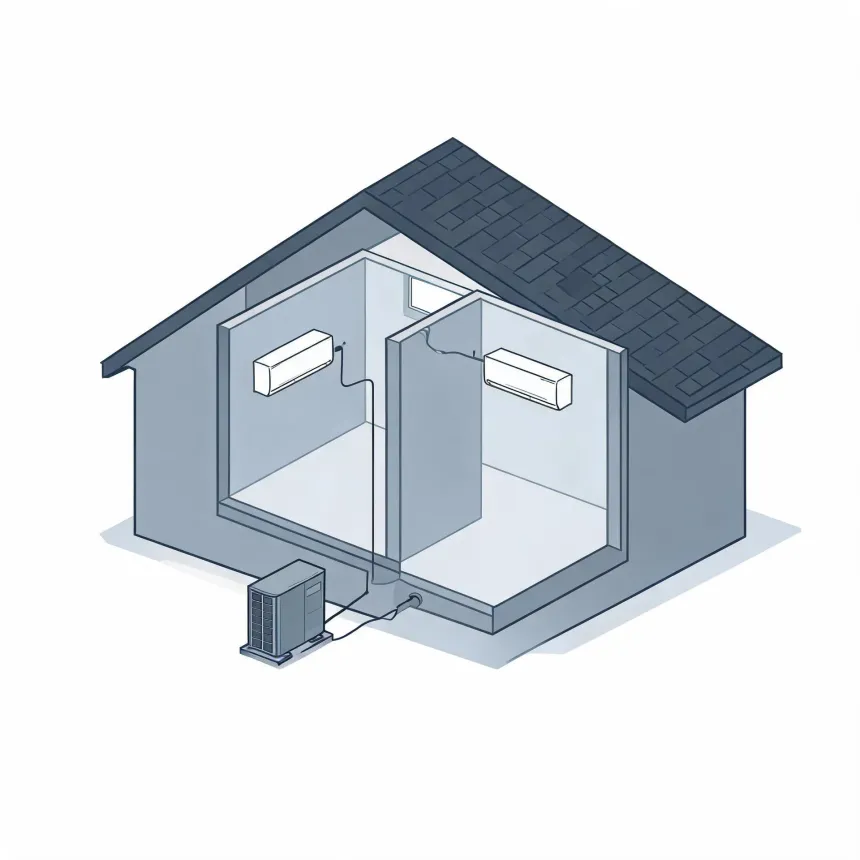
- That depends on how many indoor heads the outdoor unit runs. A single-zone system covers one room, and a multi-zone system spreads across several, with each indoor head handling one room or open area. The right number for your house depends on square footage, layout, and how much heat or cold each room loses, which is why a contractor sizes the system room by room rather than guessing at a whole-house number.
- Can a mini split heat a whole house?
- It can, if enough indoor heads are placed to reach every room. A multi-zone mini split with heads in each main room can carry a house through the 5 months a year San Bernardino needs heat, down to those 39°F winter nights. What it can't do is heat a house through ductwork it doesn't have, so every room that needs warmth needs its own head or its own coverage from one nearby. A contractor can walk the house and say how many heads that takes.