Mini Split Installation in Santa Rosa, CA
Tell us about the house, and a licensed contractor who covers Sonoma County will get in touch.
Tell us about the job
It takes about a minute.
Santa Rosa asks for heat more than it asks for cold
Your mini-split will spend most of its life on heat mode here. Homes need heat from November through May, seven months of the year, while winter nights average 40°F. Cooling barely enters into it. Summer afternoons average 79°F, mild enough that the heating side is what earns its keep.
A new unit has to meet the federal minimum either way. That means 7.5 HSPF2 for heating and 14.3 SEER2 for cooling. In a climate like this, the heating side is the one doing the work, since it runs so much longer than the cooling side ever will.
- 7 months
- November through May, your system heats
- 40°F
- the average winter night it heats against
- 79°F
- the average summer afternoon it cools against
California requires HVAC contractors to hold a state license.
The license covers the contractor, not the job. California tests and records the person or business doing the work, so it stays with them from one house to the next, but that license alone does not mean someone checks your mini-split once it's in.
That check comes from the building permit. Most cities and counties require a permit to install a mini-split, and an inspection once the work is done, separate from whatever license the contractor holds.
Sources: California Legislative Counsel · Contractors State License Board
- Is a mini split worth it?
- For most homes here, yes, because a mini split heats and cools without ductwork and this area needs heat seven months a year, November through May. It runs as a heat pump, so the same unit handles winter nights near 40°F and the milder days between. If your home is on gas heat now, a mini split gives you a way to add cooling or back up a room without extending ducts to it. A contractor can look at your layout and tell you where it makes sense and where it does not.
- How many rooms can a mini split cover?
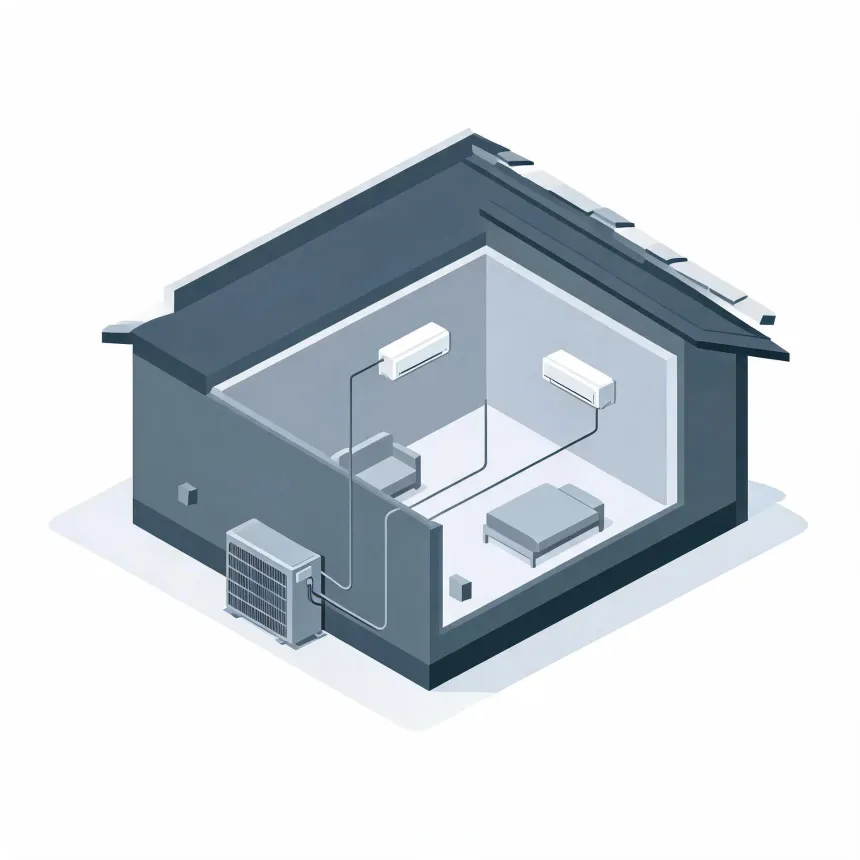
- One outdoor unit can run one indoor head or several, depending on the system. A single-zone system heats and cools one room or open area. A multi-zone system connects several indoor heads to one outdoor unit, so it can cover a handful of rooms, each with its own thermostat. How many rooms yours can cover depends on the size of the outdoor unit and the layout of the house, which is something a contractor needs to look at in person.
- Can a mini split heat a whole house?
- It can, if it is sized and placed for the whole house rather than a room or two. A multi-zone mini split with enough indoor heads can reach every room, and as a heat pump it will handle winter nights here that average 40°F. Whether one system covers your whole house depends on square footage, floor plan and how the rooms are laid out, so a contractor needs to size it for your home specifically.