
Mold in air ducts in Anaheim, CA

Send the form and the duct cleaning stops sitting on your list.

Send my request

Can mold actually grow inside my air ducts?

You've seen dark spots near a vent or caught a musty smell when the AC kicks on, and now you're wondering if mold is actually growing inside the ducts themselves or if it's coming from somewhere else in the house. Orange County summers don't get the heavy, wet heat you'd find further south or east, but your AC still runs for months, and that's enough to raise the question.

Yes, mold can grow inside air ducts if moisture gets in

Mold needs moisture, and ducts can hold onto it even in a dry climate. A leaking duct joint, a clogged condensate drain, or warm humid air hitting a cold coil can all leave water sitting inside the system. Once that happens, the dust already in the ductwork gives mold something to feed on. Anaheim summers run warm rather than muggy, so outdoor humidity isn't usually the trigger. More often it's a condensation problem at the AC coil or a duct that's been leaking somewhere you can't see. If the musty smell only shows up when the air conditioning runs, that points straight at moisture inside the system rather than somewhere else in the house.

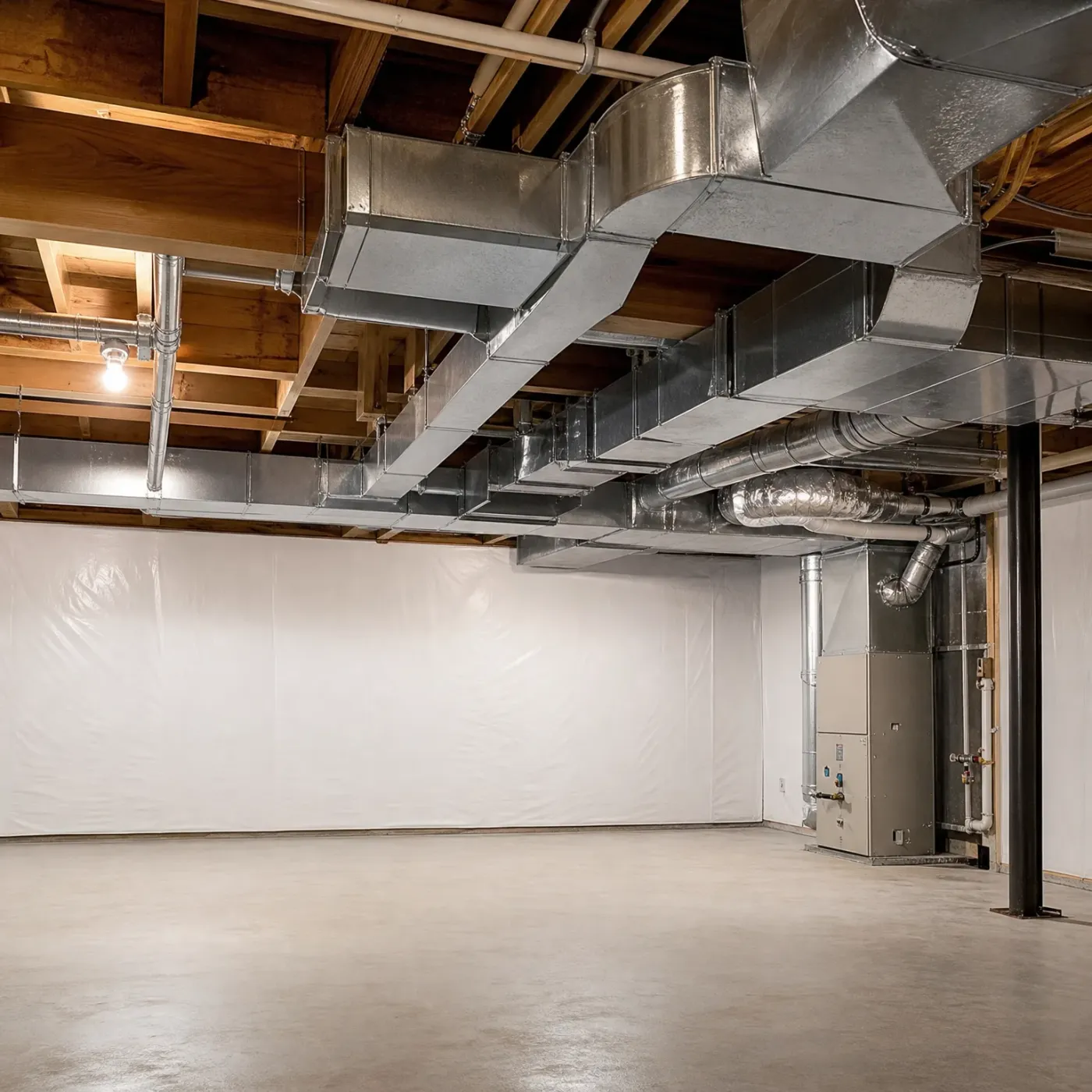
Empty concrete-walled basement room with bare floor and an exposed wood-joist ceiling carrying galvanized rectangular and round sheet-metal ducts, black pipes, and wiring.

Clean ducts, dry and clear

Metal ducts like these stay free of mold when moisture never gets a foothold. No standing water, no dust buildup holding condensation against the metal. Air moves through dry and the system doesn't give mold anything to feed on.
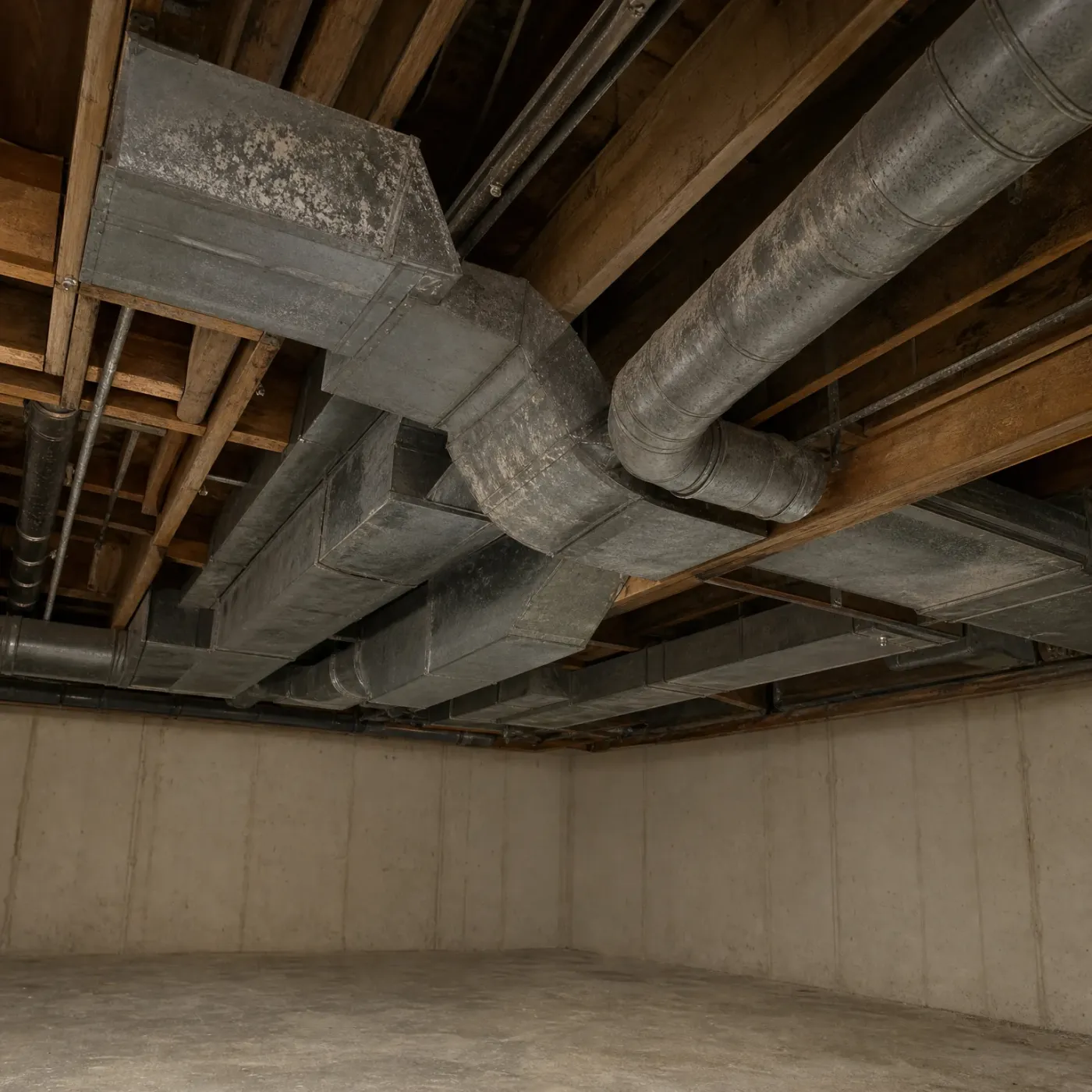

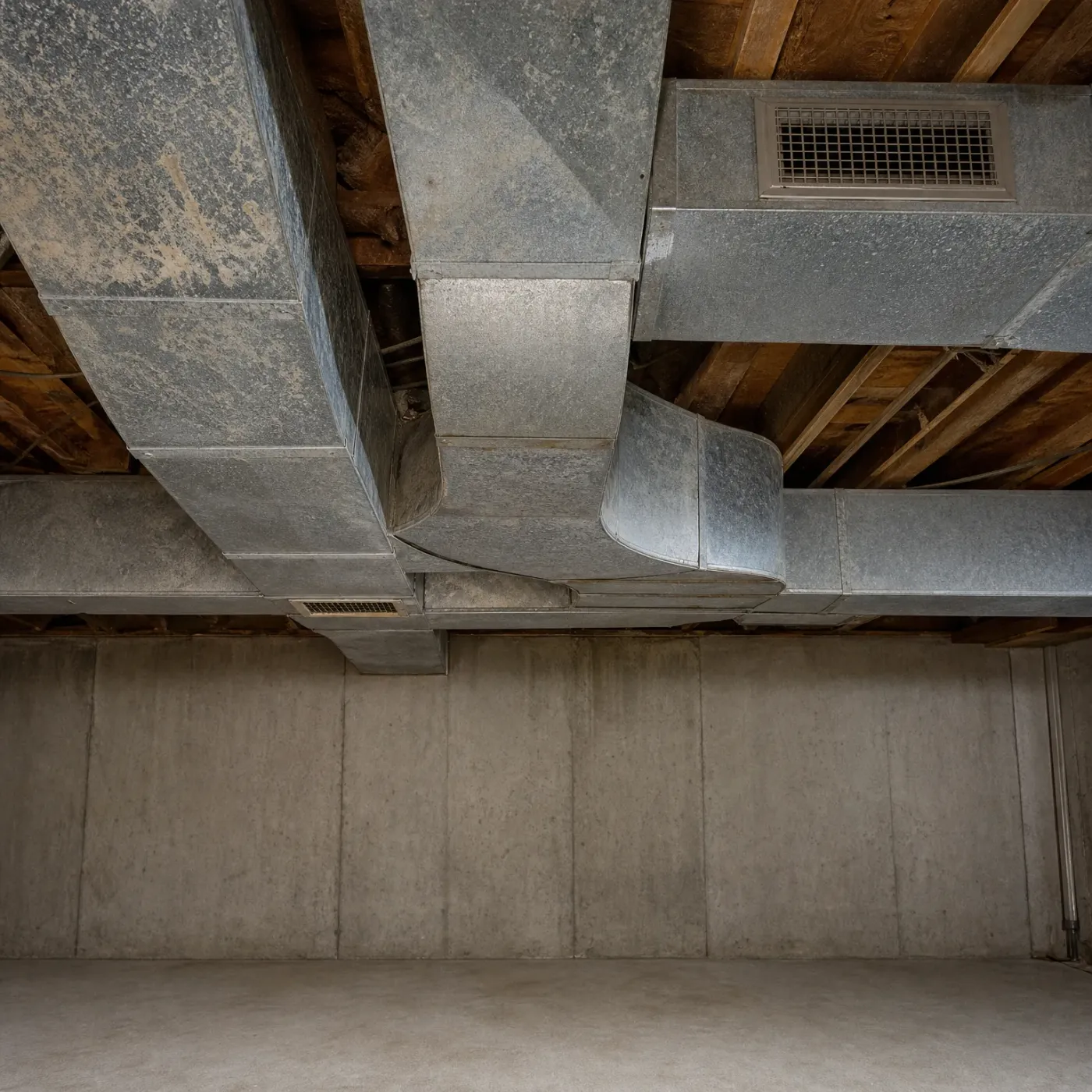
Empty concrete-walled basement room with exposed wooden joists and galvanized rectangular and round ductwork plus pipes running across the ceiling.

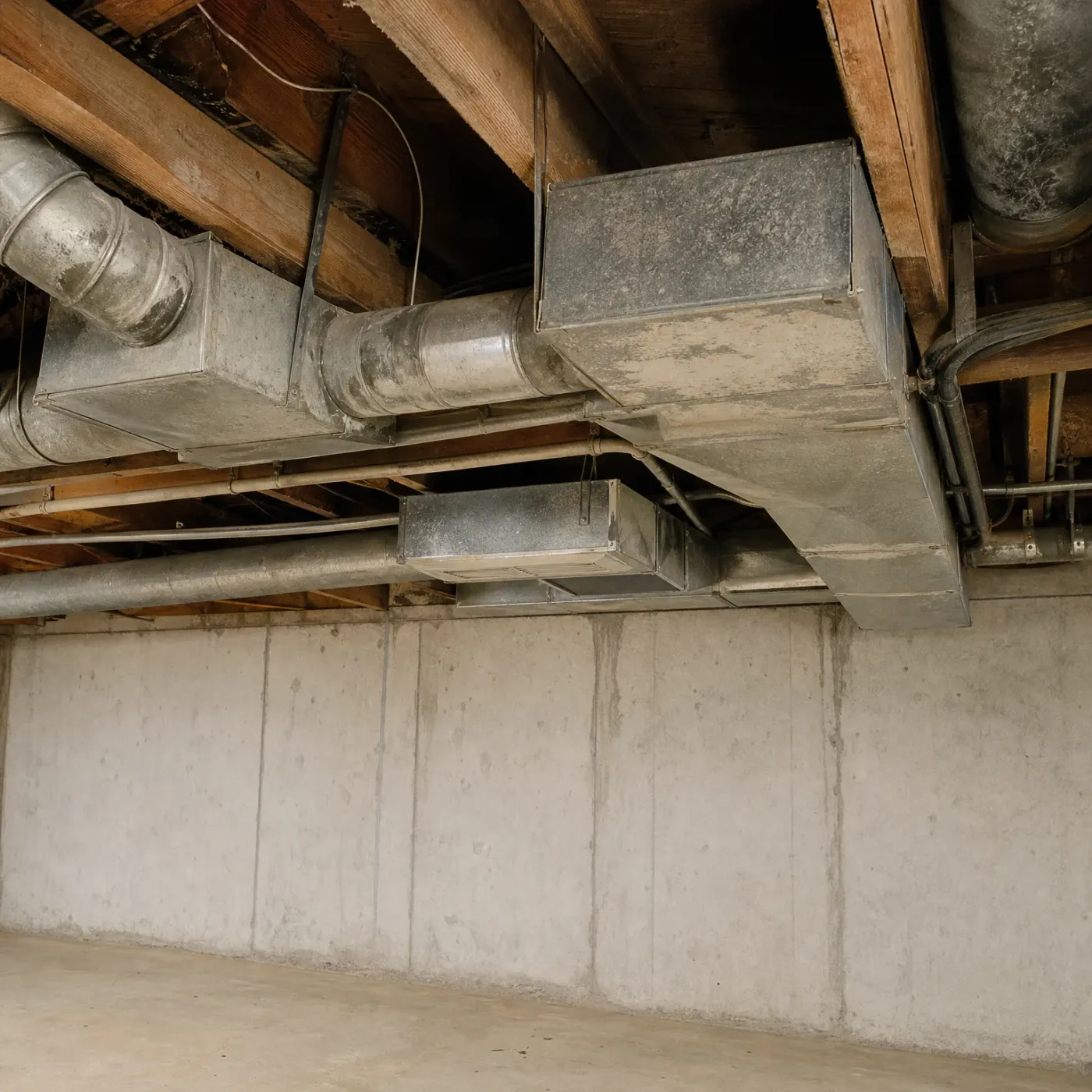
Ducts under attack

This is what years of moisture and neglect leave behind. The oxidation on the metal means water has been sitting against it, and dust layered inside gives mold something to grow on. Warm Anaheim air meeting a damp duct is exactly how it starts.

Clean It Yourself or Call Someone

Clean it yourself

  • A shop vac on the registers and a wipe-down with soap and water handles mold you can see and reach on the surface.
  • You can run it this weekend instead of waiting on a schedule, which matters if the smell is new and mild.
  • It costs you nothing but your own time, since there's no contractor to pay.
  • You won't reach the mold growing inside the duct runs themselves, only what sits right at the vent opening.
  • If the growth is feeding off moisture still getting into the system, it comes back within weeks no matter how well you clean the surface.

Call a contractor

  • A contractor with the right equipment reaches inside the duct runs, not just the vent covers you can see.
  • Someone local who services ducts in Anaheim homes all summer knows which spots in a system tend to hold moisture and grow mold first.
  • One licensed contractor handles the job, so you're not fielding calls from a handful of companies at once.
  • The cleaning addresses what's actually growing through the ductwork, not just what's visible at the register.
  • It costs more than doing it yourself, though you're not guessing whether the problem is actually gone.
  • Once the ducts are cleaned, there's nothing left growing out of sight to spread back to the vents.
A smiling man in a green sweater stands at a kitchen counter with a dark mug, with an open-plan dining area and large windows behind him.
A smiling man in a dark green sweatshirt sits at a kitchen island with a gray mug, with cabinets, plants, and a dining area near large windows behind him.
A smiling bearded man in a green sweater sits at a white marble kitchen island with a mug, potted plant and bowl of fruit, in a bright white interior with open shelving and an arched doorway.
A smiling man in a gray long-sleeved shirt stands in a kitchen looking to the side, with open shelves of dishes, a white mug on the counter, a potted plant, and a view through a doorway into a living room.

Why does mold keep coming back in my ducts?

  • Half the homes here were built by 1977

    Half the homes in Orange County were built in 1977 or earlier. Older duct runs and connections give moisture more places to collect out of sight.

  • Heat runs December through March

    Cooling runs June through October here. That's five months of condensation moving through the system, five months of chances for moisture to sit where it shouldn't.

  • Cooling runs June through October

    Heat runs December through March, a shorter stretch. The system dries out and sits idle the rest of the year, which only helps if the ducts were clean going into it.

ACS 2020-2024 · NOAA nClimDiv 1991-2020

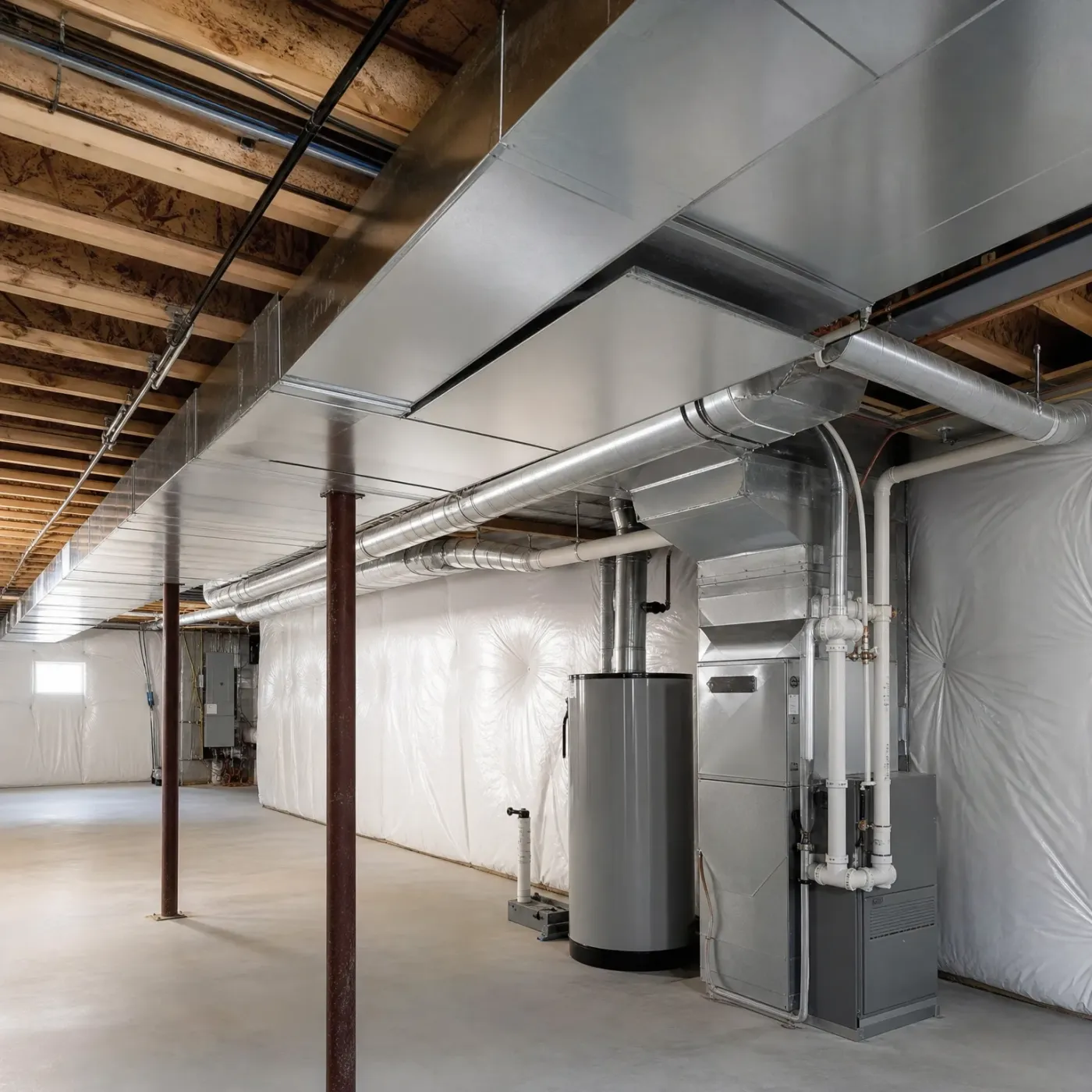
Empty basement with bare concrete floor, white plastic sheeting over one wall, exposed wood joists, galvanized sheet-metal ductwork and pipes overhead, and a furnace unit with a steel support column at right.

Dry ducts, no problem

This is what a duct system looks like when moisture stays out of it. The sheet metal is dry, the joists above are dry, and the vapor barrier on the walls keeps ground moisture from ever reaching the ducts. Nothing here gives mold a place to start.

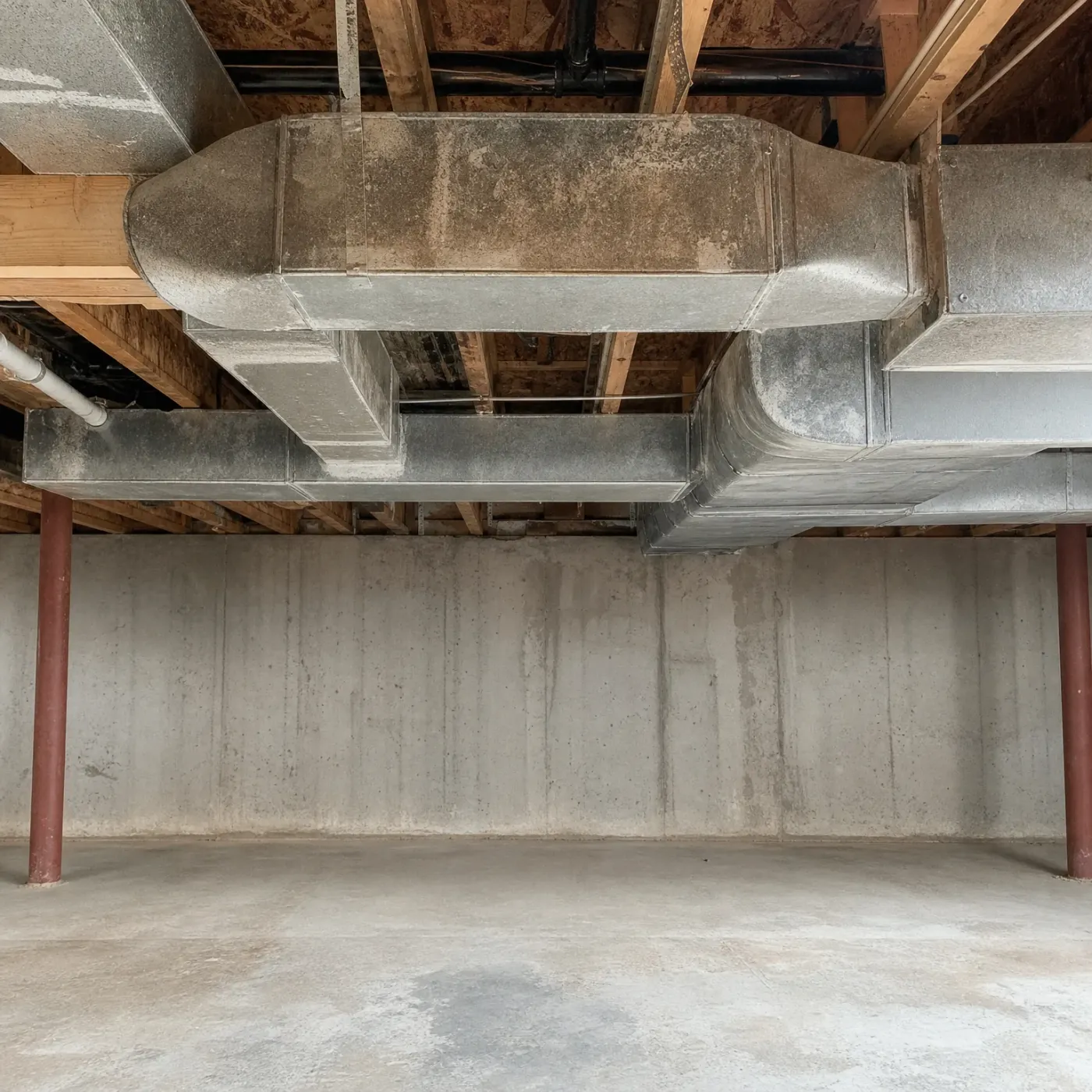
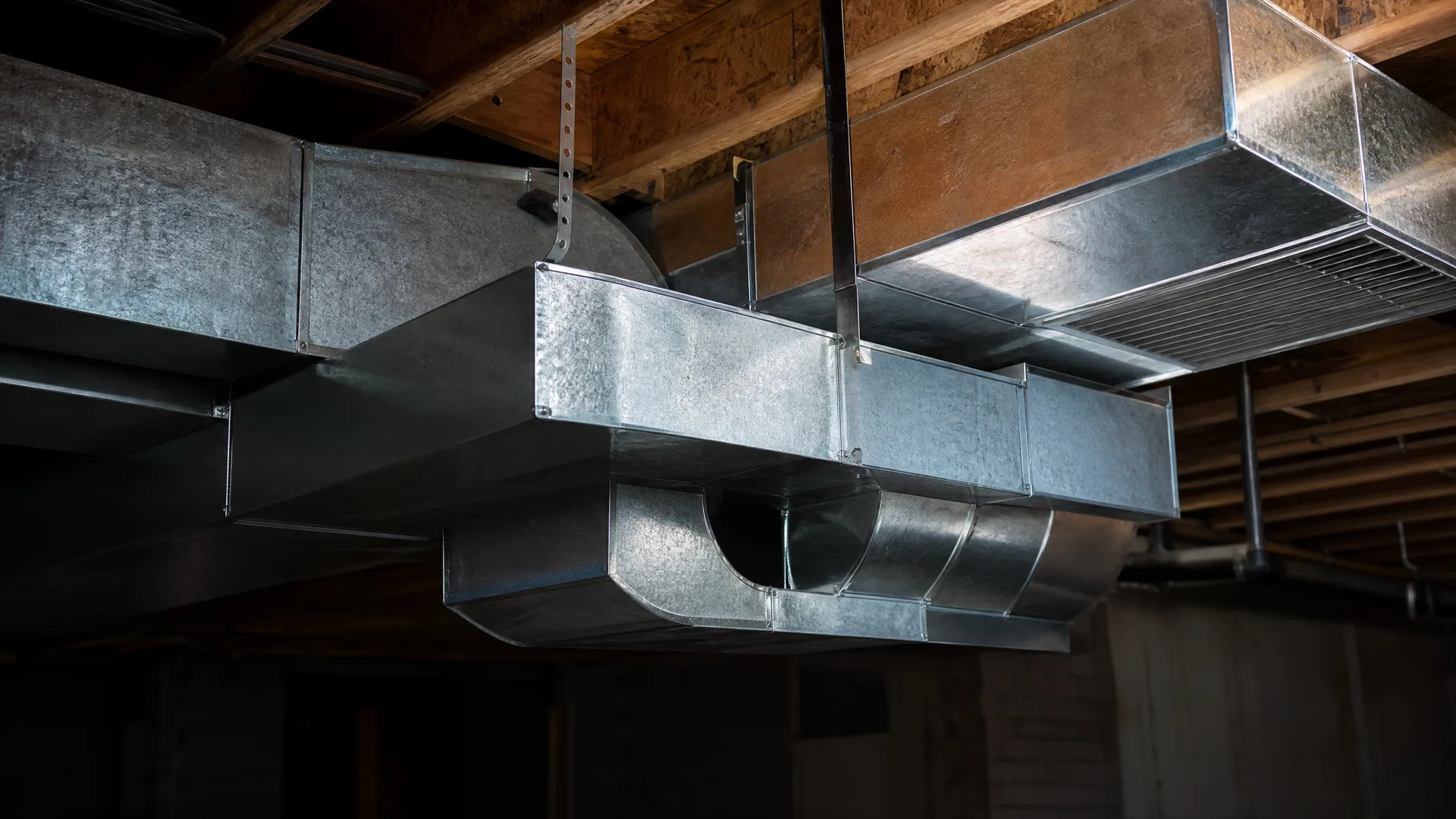
Galvanized sheet metal HVAC ducts with vent grilles run along a wooden floor joist ceiling above bare concrete walls and floor in an unfinished basement.

Low ducts, right angles, trapped air

These ducts run tight against the joists and turn sharply at each branch. Corners like these slow airflow and give condensation a place to sit instead of moving through. Bare concrete around them means more moisture in the air to begin with, right where the ducts can't dry out fast.

Unfinished basement with bare concrete walls and floor, galvanized sheet-metal HVAC ducts running beneath wooden floor joists, and two red steel support columns.
Before you get your ductwork cleaning
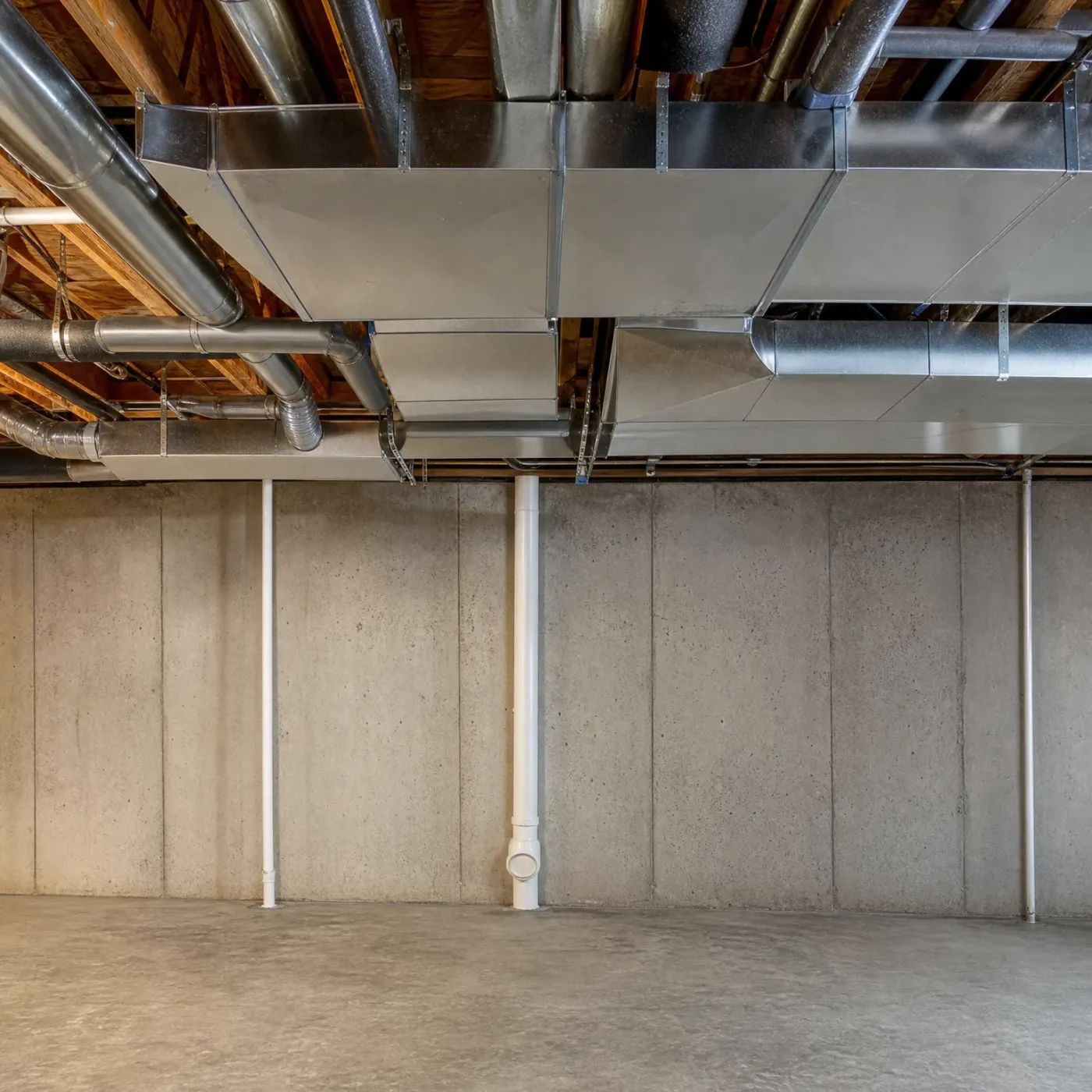
Unfinished basement with poured concrete walls, a bare concrete floor, white PVC pipes running down the wall, and exposed sheet-metal HVAC ductwork beneath wood floor joists.
After you get your ductwork cleaning

Why the AC feeds the problem

Every time the AC runs, the coil pulls moisture out of the air and that water has to go somewhere. Some of it drains off, but the air coming off the coil is cold and damp, and it pushes straight into the duct system. Cooling here runs June through October, so for five months the ducts are handling that damp air on a near daily basis. If a duct run has a low spot, a loose seam, or sits somewhere it can't fully dry between cycles, that moisture sits on the metal instead of moving through. Mold needs standing moisture to start, and a duct that stays damp through five months of regular use has more chances to get it than one that only sees occasional use.

What a musty smell actually means

A musty smell from a vent isn't the mold itself, it's a byproduct mold gives off as it grows, called MVOCs. You can't see these compounds and you can't wipe them away, but you can smell them, and the smell usually shows up before any staining does. That's why a duct can smell musty even when nothing looks wrong at the register. It also means the smell won't go away on its own once it starts, because the source is active growth further back in the duct, not a one-time spill or a dusty filter that gets replaced and forgotten.

A smiling man with short dark curly hair and stubble, wearing a navy T-shirt, sits on a beige sofa looking down toward a dark object in the foreground, with a living room, round mirror, lamp and bright window behind him.
A man with graying hair and a beard in a plaid flannel shirt stands indoors looking out a frosted window at snow-covered trees, with a ceramic mug on the sill.
Unfinished basement with concrete floor, plastic-sheeted insulated walls, exposed wood joists, metal support posts, sheet-metal supply ducts, a cylindrical water heater and a furnace with PVC piping.

Done looking for a duct system pro

The pro who gets in touch is licensed in California and works in Orange County.

Send the request and finding a pro stops being your problem.

Find a licensed pro

No charge to send it. You decide if you hire them.

Why does my house smell musty when the AC turns on?

You walk past a vent and catch it, a damp, closed-up smell that fades once the air's been running a few minutes. Maybe there's a faint ring of gray or black around the register cover, or dust that looks darker than it should. Some rooms feel stuffier than others even with the thermostat set the same. None of this is dramatic, which is part of why it's easy to let go for another month. But mold in the ducts doesn't stay put. It rides the airflow into every room the system serves, and anyone in the house with allergies or breathing trouble usually feels it before anyone else notices a smell.

A dimly lit living room corner with a gray wall, framed picture, a table lamp on a wooden side table, a beige sofa with pillows, a ceiling vent, and windows showing flowering trees outside.

It's a Saturday afternoon in April and the light through the curtains shows what the room usually hides. The ceiling vent grille has a soft gray collar of dust around its edges, thicker than you remembered. Below it, the side table has a fine film on the dark wood, the kind you can write your name in. The AC isn't even running right now, just the quiet after a cycle. You run a finger along the grille slats and it comes back dark. You'd been meaning to dust in here all week, and now you're wondering how much of what's sitting on that table came down from the vent itself.

Empty basement room with bare concrete walls and floor, and an exposed wood-joist ceiling carrying sheet-metal ductwork, insulated pipes, and recessed lights.
Galvanized ducts like these run dry between the joists, with no moisture sitting on the metal for mold to use.
Basement ceiling with galvanized sheet metal ductwork, round pipes and rectangular plenums running between wooden joists above a bare concrete foundation wall and floor.
Here the same metal runs damp and dark near the seams, exactly where mold needs a foothold to take hold.

Power here costs 32.40 cents per kilowatt-hour

At 32.40 cents per kilowatt-hour, running the blower longer than it needs to costs you. Mold buildup makes the system work harder to push air through the ducts, so a cleaning that restores airflow shows up on the power bill, not just in the air you breathe.

EIA-861 2025

Galvanized sheet metal HVAC ductwork and round pipes running along an exposed wood-joist basement ceiling beside a plain white wall.

Live with it a while longer

You keep the smell down with the windows open on mild days and a candle going when people come over. The spots near the vent stay small enough that you can tell yourself it's just dust. Nobody in the house has allergies acting up yet. It costs you nothing today, and for some houses that's a fair bet to make, at least until the register starts looking worse or someone starts sneezing every time the AC kicks on.

Galvanized sheet metal HVAC ducts and round pipes installed among wooden joists on a ceiling, beside a large blank white wall.

Get the ducts cleaned now

A contractor opens the duct system, pulls out what's built up on the metal, and checks the places where moisture tends to collect, the seams, the low points, anywhere air moves slow. You get a straight answer on what was actually growing in there instead of guessing from a smell. The air coming through the vents afterward isn't carrying whatever was sitting on that metal all summer, and the system isn't working as hard to push it through.

Mold in ductwork grows where moisture sits and air doesn't move, and the fix is getting it out and keeping the coil draining the way it should. You've seen what feeds it: the AC running five months a year, an older duct run that holds damp air longer than it should, a musty smell that doesn't go away on its own. A cleaning clears what's there now. A contractor who works on Orange County duct systems every cooling season has seen which joints and runs collect moisture in homes like yours, and knows what to check so it doesn't just come back. Send the request once and it goes to one licensed local contractor, not a handful of companies competing for the callback. You don't need to figure out which company to trust or wait on hold to describe what you're seeing. The smell near the vent and the gray ring on the register are telling you something real, and now you know what it is and what it takes to clear it out.

Galvanized sheet metal HVAC ductwork with rectangular trunks and round takeoffs suspended from wooden floor joists in an unfinished basement ceiling.

It's off your list after this

Duct and vent cleaningDucts or ventsOrange County, CA
Step 1 of 2

What ZIP code is the job in?